Consortium of Undergraduate Law and Justice Programs
  • About
    • Membership
    • Board of Directors
    • Bylaws
    • FAQs
    • Contact
  • Resources
    • Blog
    • Programs
    • Syllabi
    • Teaching Resources
    • Advising Resources
    • Undergraduate Research Prizes and Publishing Resources
    • Organizations & Research Institutes
  • Jobs
  • Awards
    • 2024 Call For Award Nominations
    • 2023 Awards Recipients
    • 2022 Awards Recipients
    • 2021 Awards Recipients
    • 2020 Awards Recipients
    • 2019 Awards Recipients
    • 2017 Awards Recipients
    • 2016 Award Recipients
  • Meetings
    • 2023 Pre-Conference Workshop
    • Pre-Conference Workshop RSVP
    • CULJP Meetings
  • Newsletter
  • Virtual
    • 2020 CULJP-Sponsored Law &Society Association Virtual Meeting

Global Citizenship in Socio-Legal Studies - Raul Sanchez Urribarri

1/24/2019

4 Comments

 
International mobility for college and post-graduate students has become a major priority for academic institutions in the United States and worldwide.  We live in a ‘global’ era, and there is growing recognition that the university’s mission should include helping students to become responsible global citizens. This is especially relevant in the social sciences and, in particular, in socio-legal studies, a field that offers fertile ground for developing perspectives, skills and an ethos framed around becoming responsible global citizens.  Technological changes, rising student demand, the pressing needs of university administrators to pursue this goal and, most importantly, the faculty’s awareness of its importance and genuine interest mean that global citizenship will continue to be an important topic for years to come.  

Global Citizenship education “refers to a sense of belonging to a broader community and common humanity. It emphasises political, economic, social and cultural interdependency and interconnectedness between the local, the national and the global.” (UNESCO 2015).  According to this paradigm, students should see the processes and phenomena associated with globalization not only as a global trend that opens up opportunities for individual economic improvement, but also responsibilities and duties towards our fellow citizens in an ethical, principled manner.  Moreover, the call is not only for students – a sense of mission in higher education based on global citizenship must be embraced by faculty and staff as well, along with the rest of the academic community.  

A pedagogy based in global citizenship is particularly important in socio-legal education across all levels.  Some of the most pressing issues covered in socio-legal studies curricula, affecting the lives of millions of people, have a strong international/global dimension and can be best understood (and taught) accordingly.  This is obvious in the case in courses that cover the socio-legal implications of a variety of topics of a global/transnational nature – such as migration studies, global warming and environmental issues, indigenous rights, cybercrime, terrorism and international development / poverty, global/transnational policing (just to name a few).  This involves reflecting about the themes in question with a global view, debating their ethical dimension with a special sensitivity towards this dimension, fostering a critical perspective that embraces key values of recognition, inclusiveness, equality, sustainability and social justice. This is, it allows educators to enhance empathy, difficult to accomplish but desperately needed in this day and age.

However, even topics/realities that are usually explored, taught and researched in a specific location or domestic context could (and should) be explored with a comparative/international outlook, establishing their relevance in a global context, cultivating a genuine sense of curiosity and responsibility.  This applies even to those areas that we have traditionally covered from a local/national lens, such as civil rights activism, police practices, disability rights, punishment, judicial adjudication and other themes.

​Many teaching and learning modalities can be employed to advance Global Citizenship in Socio-Legal Society Studies – from including key classes/topics in our curricula, to different modes for delivery specifically devised with this goal. We would love to hear more about the different examples of tactics/strategies readers follow in their courses, and the extent to which they have been successful (or not).  We want to know more about what resources you use, and whether (and to what extent) you receive institutional support. Quite often, universities and colleges express a need for ‘internationalization of the curricula’ and expect faculty to follow through, but without providing the tools and backup needed to this end.  We hope this blog can help to fill this gap.  

​Of particular note are the different initiatives that involve physically moving outside of the spatial social, cultural and political context where the academic life of staff/students usually takes place – that is, initiatives that involve ‘global mobility’, especially study tours.  This initiative has special resonance for Socio-Legal Studies and is a topic that I am very keen to discuss further with other colleagues. Shameless plug:  At La Trobe, together with my colleagues Trevor Hogan and Terrie Waddell, I co-coordinate a research-oriented Study Tour that brings undergraduate and post-graduate students from Melbourne, Australia to New Orleans and the Mississippi Delta region over the course of three weeks.  It is interdisciplinary by nature, with a very strong emphasis on Civil Rights and Social Justice in comparative perspective. I hope to share my experiences in detail in subsequent posts.  

We look forward to your comments.    
Raul Sanchez Urribarri 
E-mail:  [email protected]    
Note:  For readers who feel coy about sharing their experiences in the blog, feel free to contact me and I will be most happy to discuss over e-mail and/or include part of our joint reflections in a future blog post if preferred.
 
Raul Sanchez Urribarri (PhD, LLM) is a Lecturer (Assistant Professor) in Crime, Justice and Legal Studies at the Department of Social Inquiry, La Trobe University, Melbourne, Australia.  He is a Member of the Law and Society’s Board of Directors at the Consortium for Undergraduate Law and Justice Programs (CULJP) since 2018.
4 Comments

Undergraduate Law and Society Journal - Sanghamitra Padhy

1/18/2019

0 Comments

 
In the Fall of 2013, Dr. Mihaela Serban and I collaborated to launch the Ramapo Journal of Law and Society. A casual pondering about student research and publishing opportunities in a convening group (department) meeting sparked the initiative to start an undergraduate journal in law and society. We hoped to provide a space for students at Ramapo College and around the country to publish and engage in a conversation on socio-legal issues, and also an opportunity for students to learn the art of curating work for a journal, from soliciting papers to the review and editing process to final publishing. With support from enthusiastic colleagues and Deans Samuel Rosenberg and subsequently Aaron Lorenz, the first issue of the journal went live in Spring 2014. We have had submissions from Ramapo College and other places in the country (Allegheny College, Appalachian State, California State Long Beach, Drake University, Rutgers University, Southwestern University, SUNY Fredonia, and UC Berkeley). The essays published reflect an interdisciplinary approach and have been on an array of issues such as immigrant and refugee rights, community recovery and healing after mass violence, workplace discrimination and LGBT rights, reproductive health, affirmative action, recidivism, and reversal legislation in senate. The submissions are from varied fields of the social sciences and the humanities including sociology, communication arts, political science, history, law and society, legal studies, government and justice studies, and criminal justice. 

The journal evolved from advising senior research projects. Ramapo’s Law and Society senior capstone is a two semester, sequential, thesis course, which requires students to conduct independent research and write an extensive thesis. Advising senior research projects is undoubtedly a rewarding process, but it also presents many challenges, one of which is helping students learn how to articulate ideas to a wider audience and grow as scholars. Many times, student papers have immense potential but rarely grow beyond the constraint of the grade culture. Through the journal, we hoped to provide a voice to student research, bring enthusiasm and ownership of their ideas, and engage with student scholarship in other institutions as well. However, given that most of the submissions have been from seniors, the interaction has been mostly limited to student editors and readers. The choice of an online publication platform (which we adopted), unlike traditional publications, hopefully will bring more readership and address some of these concerns.    

The journal is a baby step to creating life-long scholars, and familiarize students with the scholarly world of research and publication. While universities have a culture of promoting collaborative research between professors and students, this is a challenge at small liberal arts institutions. Our students are not as familiar with the entire research and publishing process; setting up an editorial team is a step towards collaborative learning and enculturating students into the scholarly world. Editing is one of the primary tasks of the publishing process, as it brings many skills together. The review is a collaborative process, it gets editors to read and critically reflect upon the merits of the submissions, and make recommendations in group meetings. This opens an entirely new level of research and engagement for them, as they are not only working with submissions on topics they may or may not be familiar with, but are also constantly challenged to seek the boundaries or the core of law and society, given the interdisciplinary focus. Students also work with authors on polishing their pieces for publishing, providing constructive feedback. Students learn the tough skills of working with timelines and negotiating with authors to revise and submit within deadlines. Review meetings are some of the more interesting ones, because they add a completely different level to how students read and engage with materials— a pedagogical moment that one wouldn’t get in a classroom setting only. Many of the skillsets learned in the process of editing do translate to their own work at the senior capstone level as well.   

The journal is published annually through the collective efforts of numerous undergraduate student editors, a chief editor, and faculty advisors. We have been fortunate in having great student involvement and some excellent student chief editors Jonathan Mangel (2013-14), Molly Hopkins (2014-15), Amer Garlasco (2015-17), Antonino LaRosa (2017-19). Each of them has brought their unique signature to the journal. Jonathan, of course, did some heavy lifting in setting up the journal, Molly introduced a blog page on contemporary legal issues, and Amer steered the journal’s social media page and publicized the journal. As our program has grown, we have also expanded our faculty advisors: Dr. Jefferey Ellsworth, who recently joined the law and society program at Ramapo, has also become an instrumental part of this group. 

​The rewards have been fulfilling, more importantly it has allowed us to work with a team of enthusiastic students. Guiding student editors through this process is a reflexive teaching moment. It not only gives a chance to work with a young curious group but also provides a glimpse into how they engage with their peers and work collaboratively. It is a joy to see their sense of accomplishment when they see the journey of an essay from a submission to a revised and published paper. Like most endeavors, challenges remain, most of all in sustaining interest and flow of submissions. We have considered collaborating with other institutions as an option, but it remains unexplored. This is something we need to work on; ideas and suggestions of how we can grow and sustain will be much appreciated. 
 
Ramapo Journal of Law and Society can be accessed at: 
https://www.ramapo.edu/law-journal/archived-journals/
0 Comments

January 13, 2019

1/13/2019

0 Comments


Creating Unparalleled Pathways for Undergraduates to Recognize Their Own Research Potential 
Danielle S. Rudes

Picture
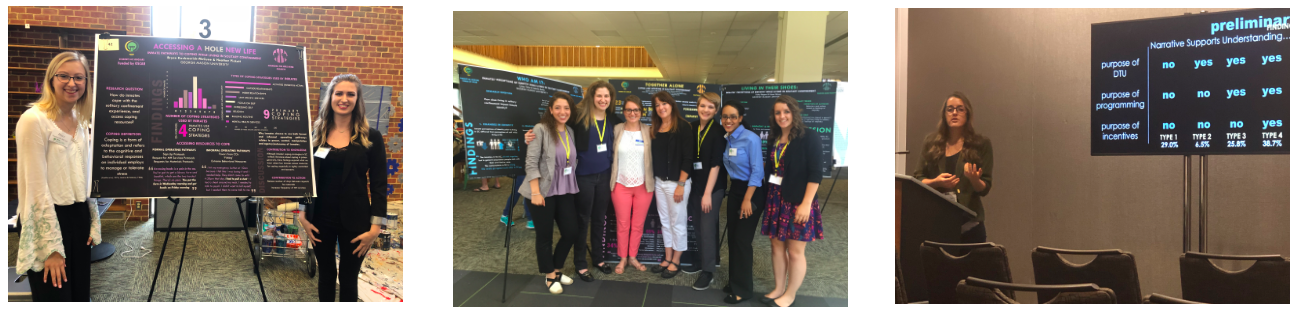
Pictured above: (far left) GMU Undergrad Student Researchers Bryce McKune & Heather Pickett, (center) GMU 2017 summer research team: Sabrine Baiou, Casey Tabas, Shannon Magnuson (ABD), Dr. Danielle S. Rudes, Kaley Regner, Liana Shivers & Karlie Berry, (far right) GMU Undergrad Researcher Karlie Berry presenting at the American Society of Criminology meetings, 2019

I consider it my life’s mission to make research come to life for undergraduate students. When I was an undergraduate myself, many years ago, maybe the opportunities existed at the small state university where I went for my undergraduate degree, but I did not know about them. To me, research was something that occurred in scientific labs with beakers and microscopes and something that people far smarter than me or far more astute were able to undertake. I was just taking classes, working a part-time job waiting tables and working in the campus television station at night trying to make sure that a bachelor’s degree would eventually hang on my wall. Today, as an instructor, researcher, mentor, and professor at a major R1 institution, I am incredibly blessed with finding a pathway to academia, to research, and into a life I greatly admire and I am eternally grateful for.

What I understand most deeply about my own work now and the work that my undergraduate are currently doing with me is that it is not enough to tell them about available opportunities, it is not enough to tell them how the transferable skills they will learn through those opportunities will be great whether they become academics or not, and it is not near enough to just share my own research with them. Instead, my work is about inspiring them to believe that the research WE do, together, is important, maybe a little fun, and most of all possible.

For the last two summers, 2017 and 2018, I have been the lucky recipient of an on-campus grant program started by the Office of Student Scholarship, Creative Activities and Research (OSCAR) at George Mason University (GMU). The OSCAR office is remarkable! I do not mean to assume that all universities have this level of support for undergraduate research, but  in this blog post, I will share the opportunities I provided undergraduate students with OSCAR’s help and I will foreshadow some ways this is possible at any institution, even where this level of support is lacking. 
 
I applied for and received two competitive summer impact grants to fund six undergraduate students in a way that our university had never done before. The idea was to take undergraduate researchers into the field to experience a research project from start to finish over the 13 weeks of summer. My project, which I was already going to do with my graduate students and a couple colleagues from sociology and women studies, involves going inside restricted housing units / solitary confinement units at four prisons in the Pennsylvania Department of Corrections (PADOC) to do interviews and observations with staff and inmates. We were incredibly lucky to get this kind of access to prisons. Our access was based on a long-standing relationship I have with the PADOC. But, for this blog, access is beside the point. We hired six undergraduate students who applied for our posting. I carefully crafted the ad so that students would be interested in going inside prisons to do the work, but also to make sure that I attracted students who thought that they could physically and mentally handle prison research. I was sure to point out in the ad that no experience was necessaryand there was no mandatory minimum GPA. I do this with all of my undergraduate research assistants in the undergraduate research lab that I run year-round and have for now a decade at GMU. I want research to be accessible to anystudent who is interested. There was a time commitment for this project because the OSCAR office agreed to fund the students $4000 each but they were forbidden from working in other jobs over the summer and from taking summer classes with the exception of one class during the first summer session, but only in necessary cases.
 
To make the most of the experience for the undergraduates, my graduate student, Shannon Magnuson, and I worked diligently to design a 13-week research program for our undergraduate research team that included their working on our projects (my umbrella project and her dissertation research) as well as having undergraduate researchers (in teams of two) design their own research foci. Then we undertook an intense schedule that included an orientation to get them up to speed on the project and expectations, a deep dive into the literature on solitary confinement and prisons, focused workshops on writing research questions, preparing literature reviews, qualitative fieldwork, researching in prisons, coding and analysis using Atlas.ti, drafting finding sections, creating a poster/presentation and writing a research paper (See attached summer 2018 schedule for full details). The undergraduate students accompanied my larger research team into four prisons to collect data for my project, Shannon’s project, another student of mine, Taylor Hartwell’s master’s project, the questions of two colleagues of mine, Dr. Angela Hattery & Dr. Earl Smith on race/gender in prison and their own research questions (which focused on a wide-variety of topics including self-esteem, inmate coping and philosophies of punishment). We all collected data for each other so their N would be higher and so they would get the most out of the research process. Students also participated in creating a weekly video blog of their experiences learning and researching along the way. The department, OSCAR and GMU will use these to highlight student undergraduate research at GMU and to recruit new students. 
 
Then, for weeks, they slaved away over an Atlas.ti computer screen to diligently code and analyze data related to their particular research questions. We met in groups to discuss key themes and findings, link findings to relevant literature and brainstorm the best ways of presenting their data. Each team created a final poster and presented their work at the Summer Celebration of Student Scholarship at GMU. 
From there though, the work was not over…a lesson we drilled into them from day one. The research process is on-going and it was up to them to consider whether or not to stay on that path. In the fall semester, all six of the 2018 undergraduates stayed on at the ACE! undergraduate lab to work on their projects. One team completed a full research paper and will submit for publication this spring, one student abandoned her particular project, but created a new set of research questions from the existing data and received a competitive OSCAR undergraduate research scholars grant to re-analyze the data to suit her new question(s). She will complete this work over the spring 2019 semester. Three students submitted their work to the Council for Undergraduate Research (CUR) annual event, Poster on the Hill, in Washington, DC. Two students are currently applying to GMU’s doctoral program in Criminology, Law & Society to continue this work with me at ACE!. From the 2017 undergraduate group, two students presented at the CUR Undergraduate Research Conference in Oklahoma, one presented at the American Society of Criminology meetings (on a regular, not undergraduate, panel…and she rocked it!). Another 2017 undergraduate used her paper from the summer as a writing sample and was accepted into a prestigious graduate program, one won the OSCAR Undergraduate Excellence Award (only seven awarded across GMU’s campus), and one received the Social Action and Integrative Learning (SAIL) Community Engagement Medallion, in part, based on her work with the solitary confinement project. Wow…one summer and a lifetime of experiences!
 
But, what if you do not have internal resources like OSCAR’s at your university? The easy answer comes from the old adage, “Priorities: when someone tells you their too busy it is not about their schedule, it is about YOUR spot on their schedule.” Make undergraduate research important to you; give it a primary spot on your schedule. You can make it happen without funding and without support. You can do it! It is do-able at many levels and in many ways. Here are some preliminary suggestions:
  • Start Small: work with just one or two undergraduates as you get started. Recruit them from your classes and give them a chance to do research and build their skills (and their resumes) as they learn to become your unpaid research assistant. Give them a fancy volunteer title like Undergraduate Research Assistant and see where this takes you, and them.
  • Develop Course Credit Option(s):Work with your chair, dean or provost to develop a course option for research that exists separate from directed readings and/or independent studies. We have a CRIM 498: Research Practicum available to students at GMU that is renewable (providing students need the credits). This option gives you university structure to provide research experiences to undergrads while you work with them. It may not count as part of your teaching load, but there is a formal record of the work you are doing for your CV. 
  • You Do not Need Money: I know, funds to finance research are nice, but be real…they are a luxury. Qualitative work can be relatively cheap and even free. And, if you partner with local organizations to design research questions they want the answers to, too, you can sometimes get access in ways that are not imaginable if you just go in asking to do your own research in their organization(s). Quantitative projects can also be fairly inexpensive depending on the type of work you are doing. Chances are you already have SPSS or some other statistical software program available at your university. Work with on-campus labs to reserve time for your undergraduate research team to do data cleaning, coding and analysis for your project. Once you train them, they can do this solo and you can just be on-call for questions and answers. 
  • Use the Nested Mentoring Model: (see prior CULJP blog post) where you train a group of students who then mentor/train other students in subsequent semesters. This will free up a bit of your time (though you will still need to advise and provide oversight). You can even do what we do at GMU, and get one of your graduate or undergraduate students to co-design the software training for whatever program you will use (i.e., SPSS, SAS, Atlas.ti, NVivo). After the training is developed, they can add another line to their resume each time they offer a training to a new group of undergraduate researchers. 
  • Call on Experts: Call, email or text me! I can help you set up an undergraduate lab, find ways to work with undergraduate research assistants and learn to include undergrads in your research in new and exciting ways. I can also put you in touch with the GMU OSCAR office if you would like to try to model some of what they are doing at your university/college. And, I can connect you to my colleague and friend, Dr. Shannon Portillo at the University of Kansas who runs a similar undergraduate research program or my former students, Dr. Kimberly Meyer and Dr. Jill Viglione who both run exciting undergraduate research labs/programs within their academic departments. 
 
The message here is simple. Do not just talk about research, do not just teach undergraduates how to do research…LET THEM DO IT! Bring them with you, engage with them as colleagues, as researchers and as skilled and thoughtful contributors. Do not set the bar high for them, release the idea of the bar and let them soar to any height possible. I know this sounds cliché, but it is how I run my lab and my life. And, the process and the results are both inspirational and amazing.

​Why the Consortium Has Made Me More Reflective As A Teacher
Jinee Lokaneeta

My first encounter with the Consortium for Undergraduate Law and Justice Programs (CULJP) was during a Six-week Summer program on “Rule of Law and the Liberal Arts” in Maine. The summer program felt like being in Graduate School again with tons of readings and which you feel nostalgic about only once you are out of graduate school. But there were two distinct aspects of that experience that I remember- one that we got to critically discuss the readings with the authors themselves- a rare opportunity, and two, the summer program was primarily composed of faculty who were in teaching institutions, thereby, often creating conversations on pedagogy in the Liberal Arts. To discover that there existed a Consortium that primarily focused on pedagogy in legal studies from a co-participant, the then President of the Consortium, Bill Rose (from Albion College), was quite a revelation and since then the Consortium has most of all made me more reflective as a teacher.
 
My first teaching job was in the Political Science department at Kirorimal College, Delhi University. One had to follow a centralized syllabus catering both to an annual exam as well as to ensure uniformity across colleges. When I am asked about the difference between teaching in India and the United States, the distinction between a centralized syllabus and individually crafted syllabus is always striking for colleagues in the U.S. In reality, both systems contain flexibility and rigidities in different ways. 
 
I recall a particularly important moment very early on in my teaching career at KM College. A new optional course was created on Women and Politics and some of us were unsure about its content and readings lists. Drawing on the incredible resources that were available to us, we invited teachers, scholars, and activists who had been long associated with the women’s movement in India (as I reflect more now- mostly Delhi based) to either submit pieces or let us reprint their published work but the decision was taken to publish the reader in Hindi given the paucity of such materials. All the pieces were then subsequently translated into Hindi only after a very interactive workshop in Daulat Ram College and subsequent discussions held on the translations. It resulted in a memorable edited reader on Feminist Politics: Struggles and Issues.(Delhi: Hindi Medium Directorate, 2001)with Nivedita Menon and Sadhna Arya that continues to be in circulation. But the experience was an excellent testament to what the teachers could initiate even in a centralized system. I learnt very quickly that the contours of knowledge set by a curriculum seldom restricted the creative possibilities of so many amazing teachers. For someone who had just started her teaching career surrounded by many such inspiring friends and colleagues (including my Dad), the system had never seemed as formally restricted. I hear of many changes in Indian higher education and in the same colleges and I keep meeting amazing students of some of the same colleagues. Yet I fear that the system may be mimicking a “liberal arts” formally from the west while losing its essence that already exists in many ways and could have just been strengthened with resources and support. Most undergraduate college teachers in India have no personal offices and little resources for the incredible work they do everyday.
 
But back to the U.S., where I have crafted many syllabi over the years yet Consortium conversations have made me be more self-reflexive. While some of the syllabi are easier to create because there may not be many courses on the themes that I teach in Political Science (eg Torture or Policing), I wonder if my other courses are really able to break the dominant paradigms. Sometimes limits are as much about disciplinary boundaries, departmental needs or the ease of picking a pre-existing case book for a civil liberties or constitutional law course. Recently, in a Consortium workshop, one of my colleagues said candidly- I don’t just want to know what perfect readings you get for the course. I want to know your assignments and primarily your path from taking your students from point A to point B. In some ways, the insistence on adding student learning outcomes (SLO) to our syllabi is meant to help us think about precisely that question. Yet, the bureaucratic need for SLOs to be written in assessable ways already limits the aspirational goal. Another colleague shared the ingenious way in which he uses the city as the basis of an assignment. In another consortium discussion, I learnt of the ambitious ways in which undergraduate students get involved in research projects sometimes requiring many resources and others very minimal. 
 
In all of these conversations, the passion for teaching, mentoring, and a quest for critical engagement with social justice concerns are central. While there are many formal reasons for my institution to be a part of the consortium, for me it has resulted in a community of scholars, who above all have made teaching a central part of my academic life. Even as teaching in liberal arts setting already informs such an emphasis, the desire to centrally locate pedagogy and program building in my conversations and writing about it in conjunction with my research is what I am grateful for as a part of the Consortium. As teaching loads in many liberal arts institutions increase, and research resources decline, sometimes these conversations become unexpected source of comradely resources reminding one of the joys of sharing the process of learning and teaching. And rather than relying just on individuals, colleagues, or institutions, which may vary across different contexts, the Consortium is able (or aspires) to build a more interdisciplinary and open space for such conversations to thrive.  

Research Intensive Capstone Course
Shannon Portillo

             ​May 2018 saw the first graduates of from the Law & Society Programin the School of Public Affairs & Administration at the University of Kansas. A central element of this new Law & Society degree program is a capstone course where students collect, analyze, and engage with data to respond to current research questions. This course is modeled off of a course I designed with Danielle Rudes at George Mason University. It is meant to foster an engaged learning environment. While Danielle and I have previously written about the outcomes from engaged learning courses for students[1], here students reflect on their own experiences with the research intensive course. This semester students built on an Undergraduate Research Project by Sydney Bannister funded by the Center for Undergraduate Researchat the University of Kansas. Sydney’s project aimed to explore how gender shapes the role of frontline supervisors in policing. Early in the semester a panel of frontline supervisors came to speak to the class. Then students completed human subjects training, development an interview protocol, interviewed police sergeants in the community, analyzed the data, and presented their findings to each other. Below four students from the course reflect on their experiences this semester. This summer Sydney will share her experiences at the CULJP Workshopimmediately preceding LSA. Join us by registering here. 
 
Shannon Portillo


[1]See the following for a full discussion of our earlier work with undergraduate student researchers in the classroom: Portillo, Shannon, Danielle S. Rudes, Lincoln Sloas, Kirsten Hutzell and Paula Salamoun (2013). “Students as Scholars: Integrating Research into the Undergraduate Classroom Experience” Journal of Criminal Justice Education 24(1): 68-96.

​Conducting Undergraduate Research
Sydney Bannister 

              This semester I embarked on a research journey different than my previous endeavors. Leading up to Spring 2018, I had served as a research assistant twice. My first exposure of assisting on research was through the Sociological Justice Project Summer of 2017, when I checked already coded data for errors and logged sources through Zotaro. This experience was closely aligned with what I imagined research would entail; coding, excel, numbers, etc. Fall 2018 presented a different side of research when I was tasked with changing the formatting of a paper ready for journal submission to Chicago Style. This was surprisingly fun as I got first hand insight of the researcher’s findings while diversifying my skills. Fall of 2018 also provided a new opportunity, creating my own research project. 
             With the guidance of my research mentors Dr. Shannon Portillo and Ph.D. student Nicole Humphrey, I formulated a research question. The hardest part of formulating my question(s) was feeling like there had to be a right or wrong answer available. I would imagine these feelings stems from an educational upbringing that fostered an exploration for a correct answer, not ambiguous possibility. The vagueness of my research questions scared me because I didn’t want to fail and disappoint my mentors, even though I rationally knew that ambiguity was necessary because if there was a lack of ambiguity, what would there be to research? This is more challenging because in the physical sciences there is the possibility of a cut and dry answer, and I grew up with this being the only kind of research I would think of when the term was mentioned. Now, I find that in any academic setting I cannot help but think of some research question I would like to study (making for a distracted Sydney in the classroom).
            Being a research assistant before I conducted my own research lessened the concern I would have encountered had I jumped into my own. Assisting gave me the perspective of viewing end work while understanding what needs to go into a research project. I try and imagine my research journey without the support I received from the Center for Undergraduate Research as well as my mentor and I. Just. Can’t. I would have faced such challenges writing a literature review for the first time without the advice of those who had been through the process as well as an award application for research, when I was a first-time researcher.
            Looking back, it is likely because I was a first-time semi-independent researcher that I thought I would be able to handle the process alone. I planned to conduct thirty semi-structured interviews myself as well as coding and transcribing the data alone, which is slightly laughable now. Having the Law and Society major capstone class to help me conduct and think critically about my research was essential to this project, but also my confidence as a researcher. I don’t think I would have grown the way I have this semester without my research team, because they brought ideas to the table I had not thought of as well as carrying the interview load. I think if I had conducted interviews alone this semester I would have ended up burned out and discouraged by the workload. My research team kept me afloat and excited to do more research in the Fall. I never thought research would be an interest of mine, because I imagined it as: numbers, coding, being in a lab. Yet, this past year and half I have learned it’s studying what’s below the surface, why we do what we do, and gaining understanding so we can move forward and better the communities of which we belong.

​Mentor Teaching/Learning is Positive and Effective:
Whitney Johnson 

​            My capstone class for Law and Society was the first of our program. It was led by Professor Shannon Portillo. Professor Portillo was an exceptional leader and teacher as she directed us through the tasks we had during our semester. She laid it out the first day in class that we would be interviewing police officers of different departments to get data on their roles as frontline supervisors. I thought that this approach to teaching was a great style and we learned from our research experiences being hands on. She guided us in a mentoring type of process. Research sounded scary coming into this capstone class, especially since we found out that research is never ending. With one question can come millions more where those came from. One question leads to so many follow up questions that can lead you down any number of rabbit holes. 
            “Learning by doing” (Takata and Lieting, 1987) is the type of learning we did this semester in this capstone class. Hands on learning approach has several benefits such as preparing us for real world experiences, how to communicate, how to gather data by having to critically think on your own; also this form of learning allows you to process data at your own speed and style, which is beneficial for everyone involved.  I agree with scholars that argue that teaching and research don’t not have to be antagonistic. Rather, they should be integrated in undergraduate curriculum, particularly at research universities ( Boyer, 1990; Boyer Commission, 1998: Healey 2005) Being a student that studies at an AAU school it brings me great pride and honor to be a part of this study with Professor Portillo. There really is a kind of culture that you acquire with staff and fellow students as we see in the Bennet, Boyer, Brake and Healey Research, teach the research process enhances students’ understanding of the process and discipline, as well as promotes a university culture, which values and support scholarship, this allows faculty to benefit as well while collaborating, mentoring and aligning their research goals. 
            Allowing her students to learn actively has allowed for a new experience as a student. I didn’t fully understand at first what her intentions for us were, but now that I do, I love that we were the first capstone class of our department in Law and Society. I would love to see where the research direction goes for future students. Inquiry and research based teaching facilitates student learning and engagement in the classroom find that students at all achievement levels can thrive and benefit from research experience (Apedoe and Reeves, 2006: Baldock and Chanson, 2006; Matand, Wu, and Rollin, 2011; Spronken-Smith, 2010: Spronken-Smith and Walker, 2010). With more research we could get a better understanding of what other forms of teaching/learning would benefit those studying at KU in the Law and Society department, and what better way to get data then using this theory of professors working with undergrad students who attend AAU universities. This collaboration benefits science, KU, professors and students alike, and society because answers for issues in law and society are always needed to bring a level of peace in the community.  

Middle-Aged Men Muddled in Middle Management:
An explorative look into frontline supervision and perceptions of power
By Collin D. Cox

​Overview:
This semester I participated in a capstone course designed so that each student had the opportunity to engage directly with frontline supervisors in the region to gather information regarding their positions. This analysis is based on interviews conducted with sergeants in jurisdictions in Northeast Kansas. My analysis is also informed by: (1) transcripts of other student-lead interviews with police sergeants, (2) an undergraduate research project shaped by Sydney Bannister’s Undergraduate Ressearch Award, and (3) from literature by academics such as Shannon Portillo, Kimberly Kras, Faye Taxman, Howard Risher, Janet Chan, Sally Doran, Christina Marel, and many more. This project was exploratory in nature, and is shaped by some limitations. Data collection was limited to the region. The data are also shaped by my own positionality as a young (21), white, gay man, However, the results of the research reinforce what we find in the limited academic research on frontline supervisors. My analysis below focuses on my research experience and some of the themes that emerged from my analysis. 
Research:
CITI training:During the first two weeks of the course, we were asked to participate in the CITI Training course in which the Human Research Protection Program. 
Academic review: Following our certification, we began exploring what literature already exists (and there isn’t much!) regarding frontline supervision. In “Managing from the Middle”, Frontline supervision is defined as: “serv[ing] in a critical role, maintaining relationships between upper management and frontline workers” (Kras, Portillo, and Taxman 2017, p. 1). This definition shaped the outlook of the Undergraduate Research Application formed by Sydney Bannister, which lead to the focus of our capstone course.
Purpose:The purpose of our research is to explore and understand how power is wielded by middle managers in local law enforcement precincts and how they manage their use of power in relation to their gender identity. 
The Interviews:I conducted two interviews with local police sergeants. Before each of the interviews, the sergeants signed informed consent forms. The interviews were both semi-structured to allow for a better flow of ideas and conversation in a confidential setting. I took notes of the actions/reactions throughout our dialogue and compiled all of the information (verbal & nonverbal) via transcription. Interviews focused on broad themes related to sergeants roles as middle managers, and specifically asked for narratives of how sergeants engage with their work with subordinates and superiors. 
Challenges:
One difficulty I faced during the process, was access to research participants. It was difficult to recruit people into the study. One of the more interesting findings from my analysis is how my identity may have shaped the data I acquired. 
In one interview, I felt uncomfortable on the basis of my sexuality whereas I felt comfortable in the other. Which, in regard to the perception of power, one sergeant seemingly used my identity as platform to exert his authority over me. Some of the key indicators that I noted throughout that interview included: Frequent interruption, correction of my questions, rolling of eyes, and patronizing tones and vocal inflections. This slight difference of social identity appeared to separate me from the social status of the heteronormative sergeant. In the reading “How Race, Sex, and Age Frame the Use of Authority by Local Government Officials”, “Social status can be seen as a continuum, with middle-aged white men at one end and young women of color at the other” (Portillo, 2010 p. 608) While understanding that my identity leans heavily towards one end, even the slightest difference in social identity made me feel extremely uncomfortable as I felt my status challenged greatly (You can imagine what that could mean from identities on the other end of the spectrum). However, that same individual did not have a post-high school education and felt as though his authority was challenged as my questions were ‘academic’-based and not ‘practice’-based. 
Another challenge, among the difficulty in locating sergeants in general, were locating women in those roles. When, at the beginning of the semester, we had a conversation of what it was like for women to be in these roles, many have discussed feeling as though they needed to express their title of authority to be taken seriously. As well, many felt as though they had to become accustomed to the ‘fraternization’ environment of policing. That being said, during a panel towards the beginning of the semester, one of the sergeants stated that her subordinates often found her to be “bitchy” when enforcing rules. Prokos and Padavic outline these scenarios justly, that such masculinity, “Is rendered most visible in situations where it is challenged, as when men face unemployment, enter traditionally female occupations[...], or, as in this case, when women enter jobs that traditionally had been used to confirm masculinity” (Prokos and Padavic 2002, p. 441).  
Conclusion:
The solution? I would urge for more data and research into this, especially into the day-to-day environment of middle-management as well as in interviewing sergeants from other jurisdictions and regions. This way, we can improve academia and provide sound literature to better shape policy, in training of future sergeants, and in educating the public.
This research was extraordinarily exciting in terms of being on the forefront of research. Prior to the capstone course, I knew that I was interested in continuing in some sort of higher education but having the opportunity to engage in this particular research study has reinvigorated that passion. I knew that we had a long ways to go in terms of diversifying the roles of leading figures in our society but I had no idea to what extent such intentionality, time, and effort must be taken to achieve that. This course helped me to realize that while there may be no simple solution. 


Works Cited:
Kras, K., Portillo, S. and Taxman, F. (2017). Managing from the Middle: Frontline
            Supervisors and Perceptions of Their Organizational Power. Law & Policy, 39 (3), pp.215-236.
Portillo, S. (2010). How Race, Sex, and Age Frame the Use of Authority by Local Government Officials.
            Law & Social Inquiry, 35 (3), 603-623. http://dx.doi.org/10.1111/j.1747-4469.2010.01197.x
Prokos, A. and Padavic, I. (2002). 'There Oughtta Be a Law Against Bitches': Masculinity Lessons in
            Police Academy Training. Gender, Work and Organization, 9(4), pp.439-459.

​Ground Floor Research: My Experience
Gerald Henderson 

          They say there’s a first time for everything. Doing anything for the first time can be very daunting and intimidating, but also very exciting and intriguing. I’ve taken a few courses in college that involved research, but most of them were from books or on computers and it involved lots of reading and interpreting. In my Capstone course at the end of my senior year, I had to actually get out and interview people for a project in which the subject matter was one that not much research had been done before. 
         Since this was something that I’ve never done before, it was kind of scary, but the more involved that I became with the first interview, the more interesting the actual interviews became and therefore it was more that I liked the actual research of people.   My confidence increased with the second interview as I had more of an idea of what I wanted to as although it was that much better than the first interview.  
       In the end, I think that had I done more, it probably could have been even easier and maybe even become addictive if there could even be such a thing in the academic world.  Being the ground breaker for research of a subject that doesn’t have much information and knowing that I had a hand in how future research can and will be done is very satisfying to know and it would be interesting to know how far research can go years down the road.
0 Comments

Teaching and Learning about Torture

4/20/2018

4 Comments

 
I teach a senior seminar in Political Theory at Drew University titled Torture: Pain, Body and Truth that  counts towards the Law, Justice and Society Minor at Drew and this happens to be the tenth time I am teaching the course. In these ten iterations, I have had the pleasure of teaching some of the best students at Drew from whom I have learnt a lot over the years. Occasionally, like most professors, I have organized events related to the class including panels with ACLU lawyers and Witness against Torture activists (alongside our own students); teach-in on Guantanamo as a part of a multi-university initiative; the Annual Law, Justice and Society lecture by Prof. Lisa Hajjar  and visit to exhibitions on torture. However, this time the students impressed and intrigued me in yet another manner- a constant reward of teaching. I ask them to bring in two visuals as a part of their presentations on concepts related to class and that has often been a way for me to both understand what they are thinking about as they engage with the readings but also to access some of the virtual world that students easily negotiate and initiate me into. This time, the first set of presenters picked political cartoons and that just set the trend for rest of the semester and it was really fascinating to see students relate concepts from our class to the analysis of political cartoons, and they generously agreed to collectively analyze a few political cartoons as a part of this blog. I could not think of a better way to end the semester-  this political cartoon essay reminds us of the ongoing debates on torture as Guantanamo remains open, efforts of accountability continue thanks to the amazing human rights lawyers and activists, and the nomination of the CIA director is mired in the torture policy of the Bush administration. Above all, it notes the continuation of torture and pain from ancient to modern times, across colonial and postcolonial contexts, in democratic and authoritarian regimes almost always coinciding with existing hierarchies in society.

​Jinee Lokaneeta, Drew University

A Deeper Look at the Chain of Command within Abu Ghraib
By: Shaylyn MacKinnon, Brooke Winters, Sage Johnson, and Aurie Flores
​

Picture
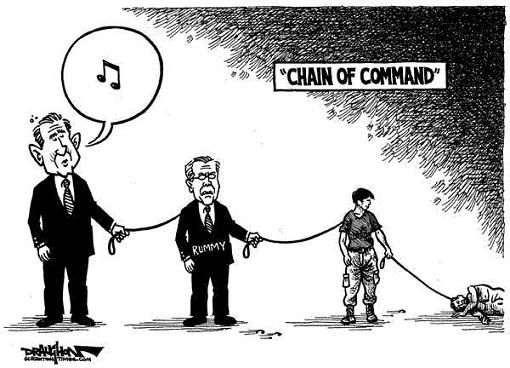
This political cartoon deals with the photographs from the Abu Ghraib prison, leaked in 2004 by 60 Minutes. This cartoon deals with the issues of responsibility within the United States military and government, directly linking the abuses at Abu Ghraib to the Bush administration. This cartoon criticizes the lack of accountability among higher-ups, as the blame for these abuses was placed solely on individual military personnel such as Lynndie England, who is depicted in the pose of one of the more infamous Abu Ghraib photographs of her holding a leash around a tortured and naked Iraqi detainee.

In the interview with Angela Y. Davis, Davis asserts that “these abusive practices [at Abu Ghraib] cannot be dismissed as abnormalities,” echoing sentiments that reject the ‘few bad apples’ explanation put forward by the U.S. government in the early days of the Abu Ghraib scandal (49). Moreover, this cartoon ties in with Basuli Deb’s work regarding the tensions between liberal feminism and transnational feminism after the Abu Ghraib atrocities. Deb writes that “US-centric feminisms at once leapt to the rescue of these women [such as Lynndie England] and portrayed them merely as tools manipulated by the military establishment” (Deb, 1). Transnational feminism, on the other hand, looks at the dynamics between gender and race, taking note of how white women became ‘good citizens’ by helping in the torture of brown Iraqi detainees. This cartoon highlights the transnational feminist perspective by showing that while Lynndie England was working for the higher up government apparatus, she is also accountable for her part in the chain of command. England, though being a woman and a victim of the patriarchy, is white and therefore benefits from that patriarchy due to the power she holds over men of color.

Looking into the actual illustrative details of the cartoon, the themes mentioned (lack of accountability and where responsibility lies in the chain of command for torture) are represented most clearly in the directions each figure is facing. Lynndie England, the lowest in the “Chain of Command” and the one who was directly involved in the torture, faces the crumpled figure of the torture victim head on, thus acknowledging her actions in the practice of torture. On the contrary, Rumsfeld's head is only slightly angled toward England, giving the impression that he is neither acknowledging nor condemning the actions that led to the crumpled and chained figure. President Bush’s face is turned the furthest from the body, his eyes closed, whistling a tune to represent how he refuses to outwardly acknowledge the torture in any way. The positions of power are indicated by the size of each character, Bush by far the largest with each body shrinking in scale as the chain. While the size decreases, the detail of each figure increases the closer they get to the tortured victim, again suggesting a refusal to acknowledge the extent of the torture the further up the command chain one is. England is the most detailed because the public has become privy to the details of her involvement in the torture, whereas Bush and Rumsfeld’s connections are obscured to the public, leaving them “clean”. This cartoon is significant to the contemporary public because of its deconstruction of the ‘few bad apples’ explanation.

References

Angela Y. Davis. Abolition Democracy: Beyond Empire, Prisons, and Torture. Seven Stories
Press, 2005.

Basuli Deb. “Transnational Feminism and Women Who Torture: Re- imag(in)ing Abu Ghraib
Prison Photography.” Postcolonial Text 7. 1, 2012.

Drughon, Dennis. “Chain of Command.” Scranton Times, Scranton Times, 16 May 2004.
​

“The Shadow”
​
By: Brielle Castanheira, Alex Gilgorri, Dalton Valette, Boshudha Khan, Sebastian Godinez
​

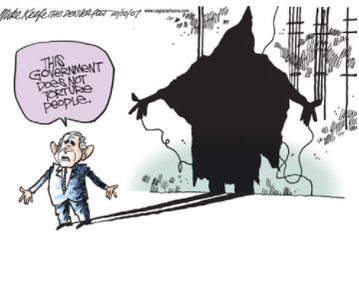
Picture
The three major themes that we identified are the bureaucracy of torture, denial of torture, and media as a form of torture. The US as a liberal democracy has conducted and denied its use of torture but evidence including the Rizzo memo counter those claims. Legal documentation similar to this show a systematic approach to the legalization of torture. The leak of the Abu Ghraib photos started a conversation about “enhanced interrogation”. This shows how media has become an evolved form of Foucault’s “spectacle of torture”, wherein privacy and autonomy are violated. In this cartoon, we see a deconstruction of liberal values, particularly seeing how the government itself endorsed these actions. The two things we noticed about the image were the shadow, figurative and literal, left by the torture conducted during the Bush presidency. The cartoon specifically states “the government”, alluding to the notion of blame on “a few bad apples” (e.g. Lynndie England). As identified by Jinee Lokaneeta in her first chapter of Law’s Struggle with Violence: Ambivalence in the “Routine” Jurisprudence of Interrogations in the United States, she notes that the U.S. denied their, “own role in authorizing the actions (denial of responsibility)” (Lokaneeta, 43). Today, we see the continued ramifications of our military presence in Afghanistan. Even though there is awareness and conversation around the US’s involvement in torture, the denial is still present.

References
Foucault, Discipline and Punish: The Birth of the Prison, Translated by Alan Sheridan.
New York: Vintage Books, 1977.
Keefe, Mike. “The Denver Post .” The Denver Post , The Denver Post, 2007.
Lokaneeta, Jinee. Transnational Torture: Law, Violence, and State Power in the United States       
and India. New York University Press, 2016.

“The Faces of Denial”
​
By: Luis Leroux, David Rosenblum, Nick Defuria, Megyn MacMullen
​

Picture
In these images of Condoleezza Rice and George Bush we see examples of Stanley Cohen’s concept of Literal and Interpretive Denial, as quoted by Jinee Lokaneeta in her book Transnational Torture, laid bare. These images react to the revelations surrounding the incidence of extraordinary rendition and the abuses which it facilitated in Abu Ghraib and Bagram. In the Rice cartoon, we see the artist, Jimmy Margulies, bring attention to the role that interpretive denial played in the construction of the American torture regime by giving officials a language through which they could downplay the severity or very incidence of abuse. In the Bush cartoon, created by artist Mark Fiore, we see the government's ability to exert its power to completely deny the existence of torture, in an example of Cohen’s conceptualization of literal denial. The contemporary significance of these cartoons relies on their modern day relevance. While the faces of torturers may have changed, the existence of black sites continue to be a blemish upon America’s reputation. They continue to operate under unethical means, utilizing the power of the state to obfuscate any information which may be disseminated.  

References
Lokaneeta, Jinee. Chapter 1: “Law’s Struggle with Violence: Ambivalence in the “Routine”
Jurisprudence of Interrogations in the United States” in Transnational Torture.
Fiore, Mark. “Top Secret.” 17 November 2005.
Margulies, Jimmy. “Rice Decries Torture.” The Comic News. 14 December 2005.

Internal Imprisonment
By Mariia, Sam, Marta

Picture
                                                                    “Captive” by Todd Tarselli

Some of the themes we related this political cartoon to were the transition from the spectacle of torture to a more private form of torture, specifically Foucault's idea that torture has become about imprisonment and detainment. Furthermore, this cartoon shows the more modern psychological form of torture. This is shown in the way he seems to be imprisoned within his own mind. This cartoon could also be demonstrating an after effect of torture in that the effects never leave and the tortured experiences post traumatic stress. Even though he may be free, torture and pain can be hard to describe with words and the experience leaves him trapped with his memories. In a contemporary sense we related this to the U.S. and its current detainee program in which they often deprive detainees of their senses using blindfolds and earmuffs leaving them only with their own thoughts. Prolonged exposure may lead to the detainee having mental issues and effectively “going crazy” from being trapped with only their own thoughts.

References
Foucault, Discipline and Punish: The Birth of the Prison, Translated by Alan Sheridan.
New York: Vintage Books, 1977.

​
4 Comments

Renee Cramer - Who, Why, and How, We Conference

4/6/2018

0 Comments

 
​Spring feels like conference season in my disciplines.  Many of my scholar friends just got back from the Western Political Science Associationmeetings in San Francisco, and many others are gearing up for the Midwest Political Science Associationmeetings in Chicago.  
 
And of course, right now, my attention has turned to the Law and Society Associationmeetings – June 7 – 10 in Toronto, Canada and to the Consortium Pre-Conference Workshop.   The Consortium will have several professional development panels at LSA – on undergraduate research, getting and loving a tenure track job in legal studies at an undergraduate focused institution, and a panel on the connections between LSA and CULJPS (they are long and deep connections!).
 
With all of the recent attention to “Manels,” as well as to the multiple ways that women are showing “we also know stuff,” I’ve been reflecting lately on how proud I am of how inclusive CULJPS is, and how inclusive my time at LSA has been (with caveats, and acknowledged limits – I find CULJPS to be really supportive of women’s leadership, and LSA to be terrific at being an inclusive and international organization; both still have room to grow).  
 
I’ve also been thinking about who I am when I attend a conference, why I go, and how I act while there.  For instance, I avoid APSAmeeting – going only once a decade or so – but I usually attend the WPSA.   I find myself at home with the public law people there, the popular culture people there, and the feminist political theory folks; and I always attend an environmental theory panel, even though they don’t usually relate to my areas of research or teaching.  I like the WPSA focus on pedagogy, the intimate and relaxed feel of it, and the ability to construct a “conference within a conference.” 
 
I presented at some graduate student conferences when I was earning my PhD at NYU in the late 1990s/early 2000s, and I attended disciplinary conferences related to my dissertation, as an observer, during the same time.  But it wasn’t until I attended the 2000 LSA meetings and the graduate student workshop in Miami Beach that I began to see myself as “an academic attending an academic conference.”  In the nearly twenty years since then, I’ve cycled through loving, and loathing, the conference process – and I’ve noticed that the wayI conference has changed over time.  When I was first out of grad school, and still working to develop the book that grew out of my dissertation, I attended in order to present.  Because I was a junior scholar, I almost always presented fully formed work, and therefore didn’t get as much benefit as I could have, from presenting work in progress. 
 
It wasn’t until my first book came out, and I switched gears, that I began to see conferences as a place to have meaningful conversations about my work and teaching – it wasn’t until tenure that I saw conferences as places to be vulnerable, intellectually.  Now, I love to be on panels where I can present work where the research is mostly done and the argument is in formation, but I am still trying out different approaches.  Even more, I love being on panels that are focused on something outside of the research, and use the research as a springboard – a roundtable on Data Access and Research Transparency, for example, or a panel on pedagogy and engaging undergraduates in research.
 
Early in my career, I understood that conferences were important places to network, even as I hated the term, and cringed at the thought.   I was lucky to have an advisor who did lots of heavy lifting on my behalf – she’d introduce me to her peers, saying things like, “Renee’s research is on ...” and when I listened closely I learned not only how she saw my research, but how to talk about it within the different subfields of my disciplines.
 
On my own, though, I didn’t start out strategically – in fact, I was such a dork! I’d actually follow senior scholars around the book room, or around the reception buffet (grabbing as much food as I could, to supplement my super small assistant professor at a state university per diem), and “accidentally-on-purpose” run into them, smile, and blunder through “I love your work” conversations.  I was lucky that so many senior folks were generous – they gave me their cards, they sat down with me to hear what I loved about their work, they invited future conversation, they helped me connect with their graduate students and colleagues.  Over time, I learned to be more strategic (and respectful) – to email in the month ahead of a conference to introduce myself and ask for a cup of coffee, to follow-up with everyone I met with an email in the weeks after the conference, thanking them for their time, suggesting an article, sending my work whenever they invited it.   I learned to ask my panel mates to meet up for breakfast before, or for drinks after, as a way of extending our scholarly connections and conversations.  
 
I learned, actually, to be much more extroverted than I am.  
 
Years later, I learned the value of three special treats: one hotel breakfast-in-bed, the ability to say no to an evening out, when I was wiped out, and the pleasures of an afternoon in a strange and fabulous city. As a new mom, I learned that conferences were also places I could sleep in, and take uninterrupted showers, and eat breakfast alone.  
 
While conferencing, I was always aware that I was making connections – I didn’t realize that I was also making friends.    I didn’t realize that slowly, over the course of a career, conferences would become the highlight of my academic year – a chance to see and talk with people I only get to see once every twelve months, as well as a chance to meet junior scholars who are just beginning to develop their research agendas and teaching personas. 
 
Time at conference is, for me, like a miniature sabbatical on an amazing fellowship – three to five days of focused conversation about my work, and your work – the chance for adequate sleep (or not) and the chance for a morning writing retreat in a new city with great coffee.  I try to do two conferences a year – more doesn’t seem sustainable (though I’ve done four, before), one doesn’t seem quite enough.  I try not to grade during conferences – except on the airplane (airplane grading is the best) – and I try to return from conferences refreshed and energize for future work.
 
I am certain that LSA will be all of that that this year – and I am incredibly excited about the pre-conference workshop that CULJP is planning.  
 
We will meet – and I hope you’ll join us – the day before, in the conference hotel in Toronto, to engage in sustained and invigorating dialogue about undergraduate legal studies. We’ll start the day with presidents – past and future – of CULJP and LSA, discussing the interplay and overlap between our two organizations, and the role of sociolegal studies in undergraduate legal studies.  We’ll network and chat at lunch – and maybe even take a walk – and then return in the afternoon for a hands-on and interactive set of sessions on program development and maintenance, curricular outcomes and assessment, and how best to serve our students. 
 
The CULJP pre-conference workshop will be an intimate gathering 20 – 30 people, and a perfect place to have a conference experience as a junior scholar new to LSA and CULJP, as well as a place for those of us who are more ‘seasoned’ to connect in different ways with our peers.  
 
I hope you will join us – register here, then email me and ask to meet up for a cup of coffee at LSA!
0 Comments

Eric Ashley Hairston- Undergraduate Research Survey

5/16/2017

0 Comments

 
Eric Ashley Hairston is an ​Associate Professor of English and of Law and Humanities at Elon University.

I am collaborating with faculty at multiple institutions to conduct a survey to collect data about undergraduate research as a pedagogical tool, specifically as a high impact practice (HIP) among faculty members who teach in the humanities, social sciences, and education at four-year colleges and universities in the U.S. The survey instrument for this study aims to collect data about:
a) the knowledge of undergraduate research as a high impact pedagogical practice;
b) the resources available for faculty to support undergraduate research on their
    respective campuses;
c) obstacles to engaging in undergraduate research;
d) the professional impact of engaging in undergraduate research; and
e) the nature of undergraduate research projects that faculty have facilitated.
 
We would appreciate your participation in the study.  Please access the survey here:
https://www.surveymonkey.com/r/H9TSZWQ

Your participation in this survey is voluntary, and your responses will be completely confidential.
 
If you have any questions, problems, or concerns throughout the process, please contact Dr. Eric Ashley Hairston ([email protected]), Dr. Anne S. Choi ([email protected]), or Dr. Crystal S. Anderson ([email protected]).  This research has been reviewed and approved by the Institutional Review Board at Elon University (#17-099).
 
Thank you for advancing our understanding of undergraduate research and mentoring.
0 Comments

Elizabeth Petrick and Alison Lefkovitz - ​The History of Patents at NJIT

4/24/2017

1 Comment

 
Elizabeth Petrick is an assistant professor in the Federated Department of History at the New Jersey Institute of Technology and Rutgers-Newark and the associate director of the Law, Technology and Culture BA program. Alison Lefkovitz is assistant professor in the Federated Department of History at the New Jersey Institute of Technology and Rutgers-Newark and the director of the Law, Technology and Culture BA program.
 
One thing that becomes strikingly clear when you do liberal arts research at a technical school is that there are significantly fewer opportunities for student research than in other fields. Certainly we encourage our students to do individual research in class. But to many students, this seems like a pedagogical activity without the real-world research consequences that their peers in other departments get to experience. Engineering, biology, chemistry, and other disciplines all demand student workers in labs, shared grants, co-authored papers, and other collaborations. In contrast, historians rarely write with others and don’t always have the research funds even to hire a research assistant. This left those in my department scratching our heads about how to give our students the same sort of research opportunities available to students in other fields. One answer was to embrace the digital humanities. And, looking to lean in to our strengths, we decided to start a website that presents the history of patents.
 
The site will provide historical context for patented innovations, in the form of written entries detailing each patent’s development, technical significance, and outcomes. In a later stage, we also hope to present the context behind which patents are filed, as well as the geographical, temporal, and personal connections between different inventions and innovations that are awarded patents through a mapping feature. This project will allow for the exploration of such connections and ultimately lead to a better understanding of who files patents and where, why some result in successful inventions and others vanish into obscurity, and, in general, the history of innovation in this country.
 
To begin, we applied for and received a Faculty Seed Grant from our university, the New Jersey Institute of Technology. This grant first allows us to build a pilot version of the website so that we can begin entering and displaying entries. The grant has also enabled us to hire an undergraduate research assistant who will generate a few entries for the website. More entries will come from a course called “Invention and Regulation” that Dr. Elizabeth Petrick crafted specifically to generate another round of entries. In the course this past fall, students could select from a range of patents that were granted to NJIT faculty, staff, and students. From there, they were put into research groups with other students who had picked the same or similar patents. Over the course of the semester, the students learned the history of innovation from assigned readings on legal history and the history of science. But they also learned about this history by conducting oral history interviews, looking at patent applications, and other primary source material on their particular patent. By the end of the course, we had several entries for the new website, which are currently being edited by a graduate student in collaboration with the undergraduate students who originally composed them. The seed grant also allowed us to hire this graduate assistant. What’s even more exciting is that we have now begun collaborations with Dr. Gerardo Con Diaz at UC Davis who will teach a course on computer and law similar to “Invention and Regulation.” His students’ entries will also be entered onto the website after being edited in the same fashion. 
 
Certainly we hope that our digital history of patents provides a service to the broader public. What inventions mattered? Why? What made their inventors successful? How did the public react to these innovations? The blog will not only introduce readers to the process of filing a successful patent; it will also allow readers to understand why certain technologies were needed, what obstacles innovators faced in creating those, and how even successful patents did not always yield significant changes in the public use of technology. But even before we have launched the site and gained an audience, we have met a main goal of the project: helping students engage in substantive original research. 
1 Comment

Jamie Longazel - ​The Unlikely, Ambiguous Feminism of Legally Blonde

4/17/2017

4 Comments

 
Jamie Longazel is Assistant Professor of Sociology and Research Fellow at the Human Rights Center at the University of Dayton. 

I teach a unit on legal education in my Law & Society course. Among other lessons, I use it as an opportunity to introduce students to feminist legal theory.

We read a chapter from Becoming Gentlemen by Lani Guinier, Michelle Fine, and Jane Balin, a chapter from What Works for Women at Work by Joan Williams and Rachel Dempsey, and a provocative essay about sexism and public bathrooms.

Students always told me the unit reminds them of the 2001 film Legally Blonde starring Reese Witherspoon, and insisted that I show it in class.

Over and again, I dismissed their pleas, even without having seen the film. How could it not be problematic?
In time, I gave in. I promised I would at least watch the movie. And if it turned out to be appropriate, I would consider showing it the following year.

The first thirty minutes or so confirmed my suspicions: It was pure garbage, nothing but stereotypes.
Just when I was about to give up on it, however, there was a shift. I stood corrected. It may suffer from inaccuracies, but we could definitely use it to start a conversation about feminist legal theory.

To my students’ delight, I have shown the film in class each of the last two years. I use it to set up an in-class debate around the question, “Is Legally Blonde a feminist film?”

I’m not about to launch into a full analysis here; after all, I wouldn’t want my future students to stumble upon this post and use it to give their side an advantage in the debate. Instead, let me simply note a few highlights from this year’s debate.

Those who argued ‘yes, Legally Blonde is a feminist film’ said…
  • The film challenges the idea that feminism is ‘anti-feminine.’ All women are included – even Reese Witherspoon’s character, Elle Woods, who studies fashion and wears exuberant amounts of pink. Feminism is about being yourself.
  • The film depicts women, as our student judge so wonderfully summarized, “unlearning the patriarchy.” For example, while Elle’s ex-boyfriend Warner pitted Elle and his new girlfriend, Vivian, against one another, in time the two became friends after realizing their shared interests as women.   
  • Rather than being saved by a man, Elle’s female law professor picks Elle up when she is down after bumping into her at the salon.
Those who argued ‘no, Legally Blonde is not a feminist film’ said…
  • This is upper class, white feminism. Women from backgrounds different from Elle’s would not be able to pull off what she did.
  • The ‘be who you are’ message aside, stereotypes remained rampant – especially, for example, among Elle’s sorority sisters, who received almost no character development. 
  • Over and again, the objectification of Elle is what placed her in the prominent positions that led to her success, sending a subtle message that she is not competent otherwise.
As you can see, students on both sides come up with some solid arguments. What I like most about the exercise is that the ambiguity makes for a good debate. I also appreciate how my law school-bound students relish the opportunity to make a case in front of a crowd, particularly the women, who, not surprisingly, tend to be much more engaged in this activity.

This year, the “yes team” won the debate. Although next year, it just may go the other way.  
4 Comments

Jamie Longazel - Solidarity in the Classroom, Wherever that May Be

1/30/2017

4 Comments

 
Jamie Longazel is Assistant Professor of Sociology and Research Fellow at the Human Rights Center at the University of Dayton. 
 
“Sit down and read. Educate yourself for the coming conflicts.” - Mother Jones

After only a week in office, Donald Trump has made it quite clear that we will facing some frightening realities over the next four years. Many of us are scrambling for ways to respond.

I love this Mother Jones quote as a reminder that the lessons can precede the conflict, rather than the other way around.

The particular lesson I always come back to as a scholar-educator-activist is Paulo Freire’s Pedagogy of the Oppressed. For Freire, true liberation – for the oppressed and their oppressors – comes when the oppressed “[learn] to perceive social, political, and economic contradictions, and to take action against the oppressive elements of that reality.”

I do not think U.S. academics appreciate Freire as much as we should. Most of us are on board with his
critique of the “banking method” of education, but his core political message about education for liberation remains on the margins of academia.  

It could be that the tendency in the Global North is to see education as apolitical. The conventional wisdom equates “political teaching” with imposing your views upon your students. Surging right-wing populism has stretched this narrative even further, in effect politicizing higher education to suit its own agenda. The “Professor Watchlist,” for instance, aims to expose “professors that advance a radical agenda in lecture halls.”
In the face of these criticisms and the parallel assault on facts that in all likelihood will continue to characterize the Trump Administration, it is going to be important that we make clear what makes teaching political and that we make a strong case for why political teaching is so important.

Teaching is a political act when it encourages students to grapple with realities that others choose to ignore, when it draws attention to oppression and gives voice to those who experience it.  

Political teaching also involves thinking about education beyond the confines of the traditional classroom. Not just in service learning or community engagement projects, but also in studying with members of our communities, particularly those who have been unable to access higher education institutions. We ought to be learning together about the forces that keep so many of us down.

As I write, I am beginning my second semester teaching a course that is part of the Inside-Out Prison Exchange Program. Inside-Out brings “traditional” college students together with people who are incarcerated to learn side-by-side in a prison setting.

Each week I will travel with students from my predominately white, relatively affluent university to a local men’s correctional facility. The course will unfold under the assumption that we are all equally capable and our voices equally valuable. Experiential knowledge and academic knowledge will have equal weight. Everyone will read the same readings, write the same papers, and participate in the same discussions. Although I will distinguish myself to a degree as the facilitator, I will sit in the circle along with the students, listening, learning, and resisting the urge to lecture.

The title of this particular course is Crime & Inequality. The name may imply an endless string of charts and stats about disparities in punishment, offending, and victimization. However, the crux of what I do is use crime as a jumping off point for an in-depth discussion about identity and oppression.
The focus, therefore, is out of step with traditional criminological approaches focusing on “them” as offenders or the subjects of social control. Rather, guided by a combination of critical writings and our cumulative experiences, we will be looking at issues like criminalization across history, the politics of crime, rape culture, and the criminalization of resistance.

What will gradually get unveiled is how complex, interwoven systems of oppression affect each of us differently. We will all struggle through the difficult reality that we, too, are complicit in such systems. Through deep reflection and honest discussion, we will also come to understand better the roots of our own day-to-day hardships.

The process, more so than the result, is what makes Inside-Out worthy of the label, “transformative education.” The program provides participants with a real-life example of what solidarity across difference looks like. Our experiences with oppressive systems mostly differ, yet I approach this course appreciating the possibility of finding unity in the shared experience of struggle.

Engaging with identity therefore gets us to this point, yet transcending identity is the larger goal.
Education, we might say, imitates life in this way.
​
As we enter a moment of profound uncertainty, it is my hope that life might also imitate this style of education. With truth seeking, reflection, and dialogue all under assault, our task will be to get at the root of our struggles, to become empowered enough to push back, and to stand in solidarity with, learn from, and inspire those who are engaged in struggles of their own. Following the advice of Mother Jones, what we need to do as we prepare is sit down and read – or, better yet, learn – together. 
4 Comments

Matthew Canfield - What Does Trump Mean for Teaching Socio-Legal Studies? Rethinking Race, Law, and Sovereignty through a Global Perspective (part 2)

1/27/2017

0 Comments

 
Click here for part 1.

Teaching Law & Society Through a Transnational Lens

In her recent book, Law and Societies in Global Contexts, Eve Darian-Smith (2013) argues that mainstream law and society instruction has too often limited the scope of “society” to that within the domestic nation-state. This has not been because of narrow foresight, however.  Rather, it was because the field of socio-legal studies was largely shaped by a set of political horizons within which the nation-state predominated as the central scale of social justice claims. Socio-legal scholars have therefore often taught their students about the heroic struggles for rights and equality by labor activists, women, people of color, and queers in seeking recognition or redistribution from the nation state. Yet in the face of an administration that has both amassed its power by rebuking these victories and also seems to foreclose future possibilities of protection, how might we use this as an opportunity to reconsider how we teach about law and society?

Teaching Law & Society in a transnational perspective means situating American law within a history of settler colonialism, a legacy that has persisted most visibly in the recent struggle at Standing Rock. Scholars of settler colonialism have revealed the enduring material logics of sovereignty and offer powerful critiques of the symbolic legitimacy of law. The historical continuity of this analytical perspective offers a frame through which to understand the shifting articulations of law, race, control over territory and resources, and larger transnational struggles for political-economic power. 

A transnational perspective also offers our students a new political horizon from which to understand twenty first century challenges of climate change, refugee migration, and global economic inequality. These issues are the result of shifting geographies of power and new technologies of global governance that are not limited to formal legality. Indicators, standards and other forms of “soft law” have all become important sites of contestation.  Hence, a transnational perspective means teaching students about the wide-ranging forms of legality that now exert control.

As we approach the Age of Trump, socio-legal studies is not only poised to help our students better understand the cotemporary political moment, but also equip them for what will surely be a difficult period for people of color, women, queer, and working class people who have long struggled for basic rights and to improve their working conditions. Understanding these struggles through a transnational context will not only reveal the underlying architectures of power through which domination is exercised, but also enlist new allies that will be important in the struggles to come. 
0 Comments
<<Previous
Forward>>

    In the Classroom:
    A Blog about Undergrad Teaching and Learning

    A group blog of the Consortium for Undergraduate Law and Justice Programs. Follow us on Twitter or Facebook for alerts about new posts.

    RSS Feed

    Archives

    March 2022
    January 2022
    June 2021
    March 2021
    February 2021
    January 2021
    December 2020
    November 2020
    July 2020
    April 2020
    February 2020
    January 2020
    October 2019
    September 2019
    March 2019
    February 2019
    January 2019
    April 2018
    May 2017
    April 2017
    January 2017
    December 2016
    August 2016
    June 2016
    May 2016
    April 2016
    March 2016
    February 2016
    January 2016
    December 2015
    November 2015
    October 2015
    September 2015
    August 2015
    July 2015

    Categories

    All
    Assignments
    Call For Papers
    Classroom Activities
    Conferences
    Constitutional Law
    Criminal Justice
    Graduate School
    Mentoring
    Prelaw Advising
    Primary Sources
    Social Justice
    Syllabi
    Teaching
    Television
    Undergraduate Curriculum And Program Design
    Undergraduate Research

Proudly powered by Weebly